Every teacher has done this the hard way at least once: a good text, a blank page, and no clear system for turning one into the other. There's a repeatable process underneath good comprehension questions, though, and it's simpler than it looks once you know what to build first.
Start with what's actually on the page
Before anything clever, get the literal retrieval questions down — questions whose answer is a specific sentence or detail sitting right there in the text. These aren't lazy or too easy; they're the foundation, because a student who can't locate what the text actually says has nothing to build inference or opinion on top of. Aim for questions with one clear, checkable answer: names, numbers, the sequence of events, a cause stated directly.
This is also the fastest set to write, and worth writing first even when you already know you'll add harder questions later — it forces you to reread the text closely enough to notice the details worth asking about, which usually surfaces two or three good inference questions you wouldn't have thought of cold.
Add a layer that requires connecting clues
The next tier isn't "harder" so much as it's asking students to do something the text doesn't do for them: connect two details that aren't sitting next to each other, or notice what's implied but never stated outright. A character's mood the text never names directly. A cause the passage hints at through two separate sentences. A comparison the writer expects the reader to draw themselves.
This is where most of the actual comprehension work happens, and where generic questions ("what is the main idea?") tend to fail — they're too broad to check whether a student did the connecting or just guessed. Tie inference questions to specific textual clues, and a student's answer will tell you exactly which clue they used, or missed.
Finish with room to interpret
Save reflection and opinion for last, and anchor it in the text even when it opens up to the student's own view. "What do you think the author wanted you to feel here, and what in the text made you feel it?" does more work than "what do you think?" alone, because it still requires evidence — just evidence used to support an opinion rather than a fact.
This is also the tier worth scaling to grade level most carefully. A strong reader can support real interpretation with real evidence, while a younger or struggling reader might need the same kind of question phrased with more concrete anchors — "did the character make a good choice, and what happened right after that tells you?"
The part worth automating, and the part that isn't
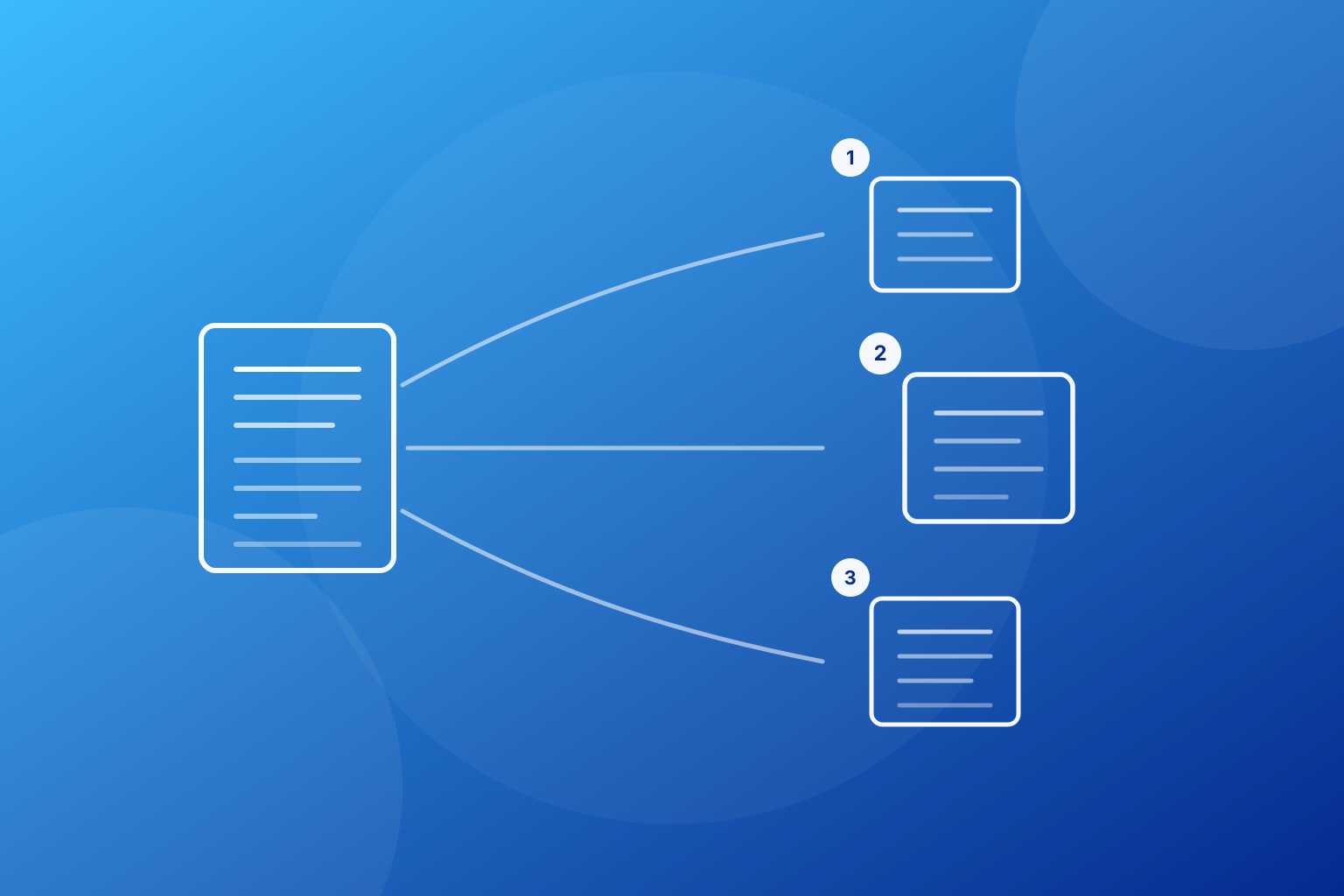
Writing one good set of questions this way, for one text, isn't the bottleneck — doing it every week, for every class, for every text, is. That's the part that's genuinely mechanical: the same three-tier structure, applied to a new passage, over and over. It's also why LessonPilot builds every generated set the same way — direct, text-based questions first, then a deliberate shift into questions that ask students to read between the lines — rather than a random assortment.
What doesn't get automated is picking the text in the first place, and knowing which of your students needs the direct-retrieval version and which one's ready to be pushed on interpretation. That judgment is still entirely the teacher's; the tool's job is just making sure the mechanical three-tier structure doesn't cost an evening every time.
None of this requires new pedagogy — it's the same structure good comprehension questions have always followed. The only thing that changes is how long it takes to apply it to whatever text is in front of you this week.